

One On One With Danny Donegan (Daniel Marmignon-Delmas)
Interview By: Ginger Coyote
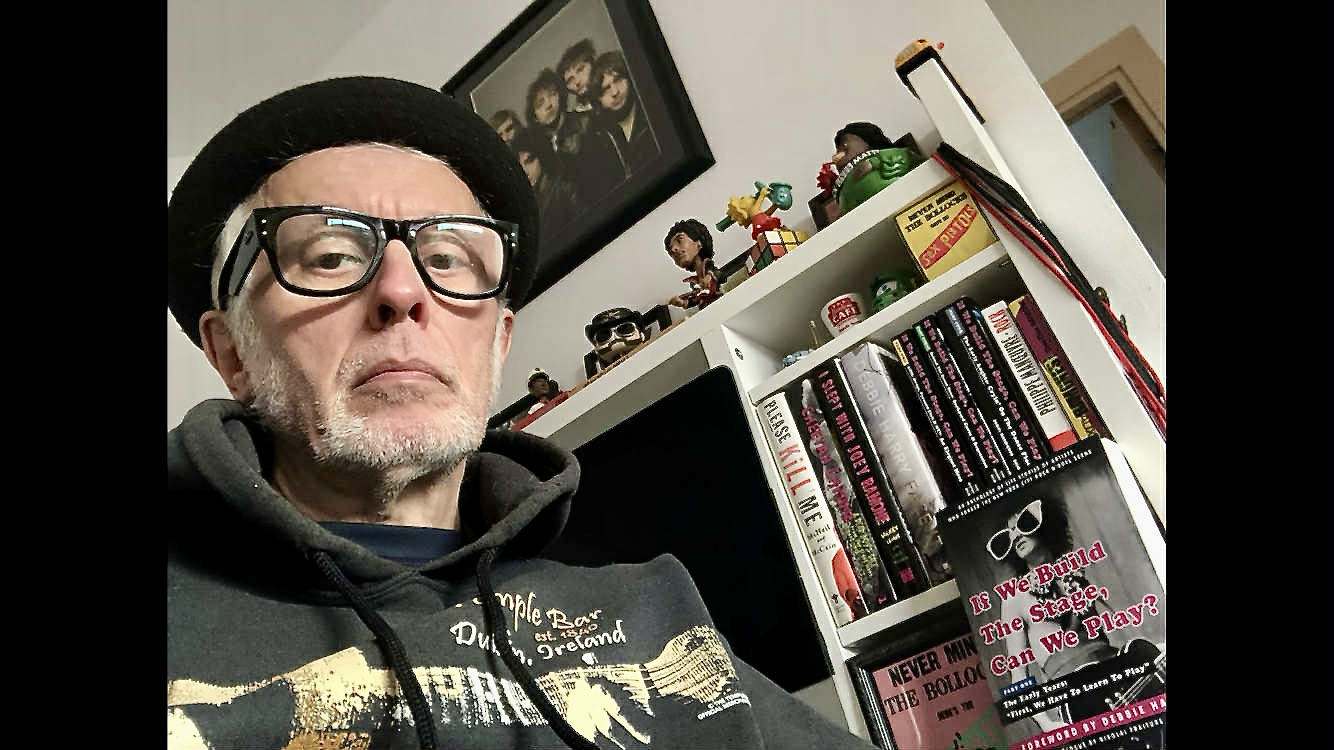
After reading four different versions of Danny’s funny and insightful book, ‘If We Build The Stage, Can We Play’? I knew I needed to find out all about him. I hope you enjoy my interview with Danny
Punk Globe: You were born in France, but your book centers around New York City. When did you relocate to the USA?
I’ve always been a rock‘n’roll junkie. Ever since I was a really young kid in the ‘60s. I was also very interested in comics, as an artist, writer, and big fan of the iconic French magazine Metal Hurlant in the ‘70s, which eventually became Heavy Metal in the US. It fused the art of comics and rock‘n’roll. You couldn’t ask for anything better.
Growing up in France in the ‘60s and ‘70s was tough music-wise. All there was on TV and radio were ridiculous, awful French variety shows. It was HORRIBLE. Rock‘n’roll was practically non-existent in France. Late ‘70s, early ‘80s, after years of rock starvation, we threw our arms wide open to punk rock and new wave, which inspired a whole generation of young French rockers. The nightlife in Paris became awesome! Le Palace, Les Bains Douches, Johnny Thunders at Le Gibus. I saw Clash, The Cramps, B-52’s, Devo, you name it. I played guitar in a band for only two and a half minutes, but it was fun.
In December 1986, I flew for the first time to America, landed in Los Angeles. It was a dream come true. Rock’n’roll heaven. Everything I dreamed of in France, I found in the U.S. I remember that Chuck Berry and Jerry Lee Lewis were giving a Christmas gig somewhere in L.A. and I had to go to a boring party somewhere else. I met lots of musicians. I remember an evening getting hammered with my buddies. That night, I got super friendly with a guy who became as drunk as I was. We were almost inseparable. I didn’t know who that guy was. The following day, my friends told me that he was Peter Case, from the legendary Nerves and also The Plimsouls. He was the talk of the town because he was releasing his first solo album. A really cool guy.
When I came back to Paris, it hit me really bad. I couldn’t stay in France. I had to go back! I felt sick to my stomach to be so far away from the life I wanted to live. I returned to the States in 1990 to discover the legendary Route 66. I also went to Nashville, Memphis, Tupelo, New Orleans. It was a whirlwind of country music, blues, cajun, r’n’r. Dr John was on the plane when we flew back. We got his autograph!
It was so incredible that I almost lost my mind when I returned to France. I drank more and more. I was a very successful graphic designer in Paris, I was making a lot of money, but I was fuckin’ unhappy. I had to leave France! One night, I was alone in an Irish pub in Paris, wasted, and a friend of mine from Boston felt sorry when he saw me in that state. He told me he had just bought a house in Portland, Oregon. I had never heard of that city. He invited me to join him there to maybe start a graphic design business. I’ve always believed that everything happens for a reason. I got rid of everything I owned in Paris and got a three-month tourist visa direction the Promised Land. That was in January 1994.
I arrived in Los Angeles five hours before the Northridge earthquake. It was pretty scary. Welcome to America! I stayed in Venice Beach for about a month, bought a car, and headed north toward Oregon. Things didn’t go as planned when I got there. I spent my last few bucks, my car broke down, and I found myself homeless on the streets of Portland for a couple of months. I met a girl, married her, got my green card and had a fantastic life in Portland, going to gigs every night. I wrote letters to the French monthly Rock&Folk sharing with them my adventures and how brilliant the music scene in Portland was. Later, editor-in-chief Philippe Manoeuvre – whom I had known since the 1970s through Metal Hurlant magazine – hired me and I became their correspondent in the United States. Later, I applied for American citizenship and got it. A dream come true!
Punk Globe: You are also a journalist. What are some articles/interviews that you have done?
I started writing for Rock&Folk quite late in life. By the way, Rock&Folk is the world’s oldest rock magazine, born in 1966! My first assignment was to write a three-page article about U2’s concert in Portland on April 15, 2001, Easter Sunday. The day Joey Ramone died. I remember Bono going on stage and announcing to the crowd that he had just heard about Joey’s death. The audience fell silent. Bono talked about the Ramones’ influence on U2, then sang “One,” “Amazing Grace,” and covered “I Remember You.” It was very moving.
And then The Strokes came along and changed the landscape of a very boring rock’n’roll scene. In August 2001, they played at the Roseland in Portland. Not on the main stage, but downstairs at The Grill. It was funny because I was drinking a beer at the end of the bar. I was by myself. At the other end of the bar, I saw Julian Casablancas walk into the room and head straight for me. He ordered a drink and stood right next to me. We didn’t know each other. I started talking to him. I showed him the latest issue of Rock & Folk, which featured an interview with Noel Gallagher from Oasis. In the interview, the Mancunian said that the best band in the world at the time was The Strokes. Julian couldn’t believe it. He was stunned. He was so young. And he was broke. I remember looking at his Converse, which were holding up with duct tape. It may be hard to believe, but this kid was really broke. Everyone who hated The Strokes liked to say that they were spoiled kids from rich families, born with silver spoons in their mouths. That’s bullshit. You can read the truth about that in my book. Anyway, that night, I became friends with the members of The Strokes.
I followed the “Strokesmania” that exploded around the world over the following months. I interviewed them several times and covered many of their shows, the biggest one being when they played with The White Stripes at Radio City Music Hall in New York City in 2002. I teamed up with legendary photographer Bob Gruen. We had a blast together. I became “the Strokes guy” for Rock&Folk, and since I lived in Portland, I was also “the Dandy Warhols guy.” The two best American bands of the moment. East Coast versus West Coast. Oh man, 2003 was a great year! I interviewed them and wrote countless articles about them.
It was also around the time the New York Dolls were getting back together. I already knew Steve Conte. One night in 2009, I was at home watching TV when the phone rang. “Hey, Danny, Steve here. We’re arriving in Portland. What can we do in town tonight?” I had to think quickly of something. I called Courtney Taylor-Taylor, the leader of the Dandys, and told him the New York Dolls were coming. Courtney was super excited and asked me to bring them to their headquarters/studio, The Odditorium. He told me he would call his chef to prepare food and drinks for them. I went to the Dolls’ hotel and picked up Steve Conte and drummer Brian Delaney. Sami Yaffa and David Johansen stayed with their girlfriends and went out to dinner somewhere, probably downtown. Then Steve said to me, “Wait, Danny, here’s Sylvain, he’s joining us.” I looked to my left and saw him approaching my car. Hell, yes! Sylvain Sylvain, one of my heroes! He sat next to me on the passenger seat. He spoke fluent French. We had so much fun. It was the beginning of a beautiful friendship that lasted until his death. The night we spent at the Odditorium was magical! The Dandys and the Dolls got along great. Steve played guitar and drums, Sylvain played guitar and piano and sang a duet with Zia. They even recorded a couple songs. It’s one of my fondest memories. I’m very proud to have been the one who brought them together. I cannot emphasize enough how much I loved Sylvain. One evening, we were texting each other, talking about our love for Eddie Cochran. I sent him a photo of my Eddie Cochran records, and he used it in his video “Leaving New York”. His chapter in Part One of If We Build The Stage, Can We Play? is probably my favorite. Funny and touching. He was heartbroken after the deaths of Billy Murcia, Johnny Thunders, and Arthur Kane. The Dolls turned everything upside down, inspired thousands of bands, and paved the way for punk bands. They became living gods, yet they never received any recognition while they were still together, and for most of his life, Sylvain struggled to make ends meet. He deserved better. He was addicted to music. He was always on his phone, listening to music. And you know what? He wanted me to co-write his memoirs. He wanted me to cover his early years, from his birth in Egypt to his adolescence in Paris and then his move to the United States, to Buffalo. Another writer would help him with the American part of his life. I was very honored that he asked me, but I had to turn him down because I wanted to focus on my anthology, which was a lot of work. To this day, I still don’t know if I made the right decision. Anyway, he was understanding. We remained friends…
Clem Burke has always been a very special friend to me. I owe him a lot. He has always supported me in my book project. He introduced me to Debbie Harry and Chris Stein. Even though Debbie wasn’t very enthusiastic at first about the idea I was presenting to her (“Oh, another book about CBGB… “), she fell in love with it when I sent her the manuscript and she ended up writing the foreword. Amazing! And like a domino effect, Chris joined us and helped me tremendously. Having the support of Debbie, Chris, and Clem, the pillars of Blondie, made me very proud! I am very grateful to them. As I said, I owe Clem a lot. Every time he came through Portland, we would meet up. In 2012, he gave me one of my best interviews by asking Glen Matlock and Hugh Cornwell to join him for an impromptu interview. Having these three legends in front of me, together, was surreal. And so satisfying. They welcomed me so warmly. I had brought a bottle of wine because I knew Clem was a wine lover. Losing him a few months ago was absolutely devastating.
For Rock&Folk, I interviewed D Generation, Placebo, Green Day, Jesse Malin, Sky Saxon, Sleater Kinney, Dum Dum Girls, Albert Hammond Jr, Phoenix, Adam Green & Binky Shapiro etc. I was on my way to Nashville to interview Loretta Lynn and discuss the album she had just recorded with Jack White when she fell down the stairs at her home and had to cancel her entire promotional tour. It really was a bummer. I covered many gigs like Batusis with Sylvain and Cheetah Chrome, Yeah Yeah Yeahs, MC5 in 2004, Dee Dee Ramone at Satyricon and many more.
Punk Globe: I have read three of the four books that you have published and I received. Some of the memories shared by the musicians are hilarious, and the photos are epic. I know you used photos by Chris Stein. What other photographers did you approach for ‘If We Build The Stage, Can We Play?’
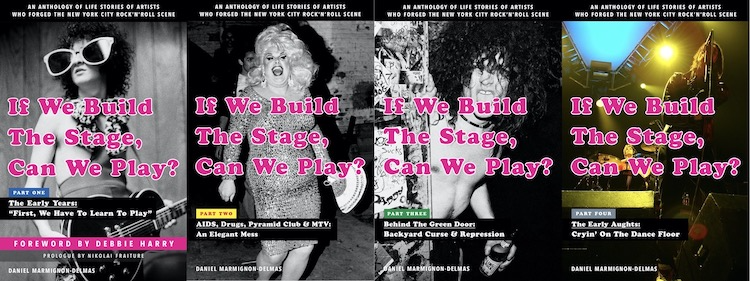
Chris Stein was a huge help. He provided me with quite a few photographs without asking any questions. The cover of Part Two featuring Divine is one of his. He even gave me some advice on how to improve the design of the book covers. Bob Gruen also helped me by giving me easier access to several of his photos. The photo of Sylvain Sylvain on the cover of Part One is one of his. I can’t help but think of Marc Bolan when I look at this superb shot. The photo of Jesse Malin on the cover of Part Three is also by Bob Gruen. I included several photos that I took myself, such as the one of The Strokes on the cover of Part Four, taken in Ireland when I was living in Dublin. Friends provided me with several photos, and I also contacted various unknown photographers, all of whom were passionate about rock‘n’roll and were delighted to help me illustrate the books. Many of my guests also helped me by sending me photos from their own collections or putting me in touch with photographers. I also worked with the great Eileen Polk. She took millions of great shots at CB’s or Max’s. Illustrating such a voluminous anthology is a huge challenge. It wasn’t easy. Most of the work was fairly straightforward, but I also encountered a few obstacles with people who didn’t care at all and were quite contemptible. Anyway…
Punk Globe: Tell us about how you came up with the title of the books?
It’s quite a long (and painful) story. In 2009, Rock&Folk sent me to Los Angeles to interview Julian Casablancas, who was releasing his first solo album, Phrazes For The Young. We met at a Vietnamese restaurant, then went to another restaurant for a photoshoot with Irish photographer Margaret Molloy. During the photoshoot, I asked Julian for permission to use the title of one of The Strokes’ songs, “Meet Me In The Bathroom”, for the title of my anthology. Julian is a really cool guy. Always smiling, super patient, and incredibly talented. He replied, “Sure! I’d be honored.” I was thrilled. I thought it was the perfect title, so rock‘n’roll, so New York. I told everyone around me and everyone I interviewed. The news began to spread throughout New York. I also had a great idea: I decided to ask the artists I interviewed to share a “Bathroom Story” that I could use to add a touch of humor to each book. A lot of things are happening in the bathrooms during gigs. I got some completely crazy and slightly grungy stories from several of the people I interviewed. It was all GREAT!
Until that terrible day in 2017, I think, when I saw on the internet that a book with the same title had just been published! It was a book about the rock’n’roll revival in New York City in the early 2000s. Not a coincidence. I was devastated. And when I say devastated, I mean FUCKIN’ DEVASTATED!!! Furious and devastated. Everything stopped. I was paralyzed. I felt numb. It took weeks and the help of my close friends to get over it. Then I started brainstorming, juggling lots of different titles, good and bad, and I remembered what Sesu Coleman, the drummer of Magic Tramps, had told me when he talked about his first meeting with Hilly Kristal. Sesu and Warhol Superstar Eric Emerson were on the Bowery looking for a place to play. They saw this seedy bar called Hilly On The Bowery. They walked into this dump and asked Hilly if they could play. Hilly told them it wasn’t a club, that there wasn’t even a stage. They asked him, “If we build the stage, can we play?” Hilly replied, “If you build the stage, you can play.” Sesu and Eric went out into the street, picked up some wooden planks and old, smelly pieces of carpet from the piles of garbage and built a stage in a corner of the bar. They were able to play. It was the very first concert in Hilly’s bar. Later, Hilly renamed his bar ”CBGB” and the rest is history.
That very first stage that they built was the springboard for what would happen later. The history of New York is full of anecdotes like this one. It was perfect for my project. It’s a long and weird title, but it makes a lot of sense and you don’t forget it. I remember talking to Nick Valensi, the lead guitarist for The Strokes, and telling him how upset I was about losing my original title. When I told him what the new title was, he said, “Actually, it might be a blessing…” That made me feel better.
Punk Globe: Tell us how you decided on four books?
At first, I thought I would write a single book, but the project grew and grew. You interview one person, then that leads you to another, then another, and so on. In fact, I started with Bob Gruen. I had lunch with him in New York. We talked for two hours about the New York scene over the years. He taught me a lot, and because of that, I had to dig deeper and deeper into the history of rock‘n’roll in New York. The history of rock‘n’roll in New York is so rich. At a certain point, I couldn’t stop. It was so exciting! And everyone helped me a lot. So I decided to write a complete book about the ‘70s, then another about the ‘80s, a third about the ‘90s, and finally a fourth about the 2000s and September 11.
I contacted hundreds of literary agents around the world to get my books published. Even if some were fans, they were all terrified at the idea of embarking on such an ambitious project. Many asked me to butcher the entire manuscript by reducing it to a single book. I couldn’t do that. It was crazy! I couldn’t betray all those wonderful people who had taken the time to talk to me, sometimes for hours, or who had met me for lunch or dinner to share their incredible stories. I couldn’t reduce it to 300 pages. It had to be the whole thing, nearly 2,000 pages. So I had to do it myself, from writing to design, layout, and publication. All my savings (which weren’t very much!) disappeared in the blink of an eye. But I had to do it. It’s my life’s work. I’m very proud of it.
Punk Globe: I realize the two I read have different subject matters. It seems like you did the same format for the books, like what Legs did with “Please Kill Me’ have the artists tell you what they remembered
Oral history books are the best. And the best of all is, of course, Please Kill Me. I wanted to recapture that same feeling. The only difference is that I didn’t want all these interviews to be cut up into a thousand pieces and mixed together according to different topics. I wanted the reader to listen to what, let’s say Jayne County, has to say. Because she’s sharing her life story. She’s not commenting on a topic. She’s sharing her memories and feelings with you. It’s like she’s having a drink with you. Or tea with cake. It’s more intimate. Read Howie Pyro’s story when he relived his first steps at Max’s Kansas City. An event that changed the life of the teenager he was. You feel everything he describes. There’s no bullshit. It’s huge! Read about Sylvain Sylvain’s encounter with Brigitte Bardot. It’s hilarious. And he really gets a kick out of remembering that. Or read the heartbreaking episode of The Strokes guitarist Nick Valensi, who lost his father when he was a child. His father taught him his first chords. You feel his pain. It’s really what I experienced. I feel privileged to have earned the trust of each of my guests. They shared their stories with me, and I simply shared them with anyone who wants to read the books. I just wanted to get the truth. To alter it as little as possible. To keep the raw transcript.
Punk Globe: You wrote about the Jayne County/Handsome Dick incident
I think you’re referring to the incident between Wayne County and Handsome Dick Manitoba of the Dictators. Wayne County (now known as Jayne County) was performing at CBGB. This was in 1976. Wayne was high on speed, like most people at the time. Handsome Dick Manitoba arrived visibly drunk. A fight broke out between the two, and Dick ended up in the hospital, half dead. What happened? There are different versions. Jayne told me that Dick had said some not-so-nice things to her, that she grabbed the mic stand and knocked him down flat. She didn’t want to talk to me about it too much because she regrets it and is now on good terms with him. Rumor has it that HDM made some very stupid homophobic comments to Wayne, which would make sense because even though Handsome Dick Manitoba was very nice to me when I interviewed him, it’s common knowledge that he’s not the most refined man alive. He’s a true New Yorker, born and raised in the Bronx. A tough guy. When the incident occurred, Peter Crowley, who was the booker for Max’s Kansas City, was Wayne’s manager. He was the one who had to deal with all the fallout from the incident.
Peter said that HDM was completely drunk and harassing people, especially Wayne. He told me that they were insulting each other, and that Dick had a mug full of ice cubes and was throwing them at Wayne. When he ran out of ice cubes, he jumped on stage, and Wayne hit him with the mic stand, breaking his collarbone. It may seem childish, but it could have ended in the death of the Dictators’ singer. Wayne was sued and Peter Crowley had to go to court several times. HDM couldn’t remember shit. His manager persuaded him to file a complaint and told the court that Dick just wanted to go to the bathroom when Wayne savagely attacked him. This turned out to be false following the witnesses’ statements. In any case, it all ended, and a few months later, Handsome Dick Manitoba and Wayne County buried the hatchet and became friends. But for a while, it created a lot of tension between Max’s Kansas City and CBGB. Which was unfortunate, because all the bands played at both venues and got along well.
I tried to use as much material as possible. As I said, I didn’t want to change the stories too much. There are always people who repeat themselves and lose the thread of the conversation. It’s your job to try to help them stay focused. And some people will remember the same events, so you don’t want to repeat the same things. I think I did a pretty good job of maintaining the thread of the story throughout those 50 years of rock‘n’roll in New York. The worst thing is when you realize that someone remembers an event that never happened. It’s pretty embarrassing. You absolutely must avoid publishing made-up stories. It’s your job to spot these mistakes and check whether they really happened.
The New York punk rock scene is a lot like a big family. Most of its members love each other, but there are a few exceptions where old grudges linger. Sometimes it seems a little childish, sometimes it’s understandable. Old rivalries or simply people who can’t stand each other. And when you write a book like this, you have no idea what’s going on between two people. I had serious problems with a couple of my guests who didn’t like what another guest had told me. That’s when things get complicated. Once printed, it’s difficult to change the manuscript. I was threatened and almost insulted because I dared to publish things they didn’t like to read. Yet at the beginning of each book, there is a disclaimer stating that each person is doing their best to remember what happened decades ago. Old age, drug, and alcohol abuse are significant factors. We must be understanding. Everyone can make mistakes. I ended up editing the manuscript several times to avoid problems. We live in very difficult times where we have to watch every word we say… and print.
Punk Globe: Besides not asking myself if I had any anecdotes. Are there others that you regret not speaking with?
Yes, of course, there were many people I would have loved to include in the anthology. Levi Dexter advised me to contact Leee Black Childers. Leee was not only an excellent photographer, but he was also the manager of the Heartbreakers and of Levi And The Rockats. He was a great guy who had to manage out-of-control junkies like Johnny Thunders and Jerry Nolan. Unfortunately, when I tried to contact him, he was ill and passed away shortly after. I really wanted to pay tribute to him in the anthology, and I did so through the story of Levi’s life and by adding the wonderful Gail Higgins, Leee’s assistant. The same thing happened with Giorgio Gomelsky after interviewing Jesse Malin, Danny Sage, and Howie Pyro from D Generation. Giorgio was like a father to them and helped them become one of the best bands in New York. He was the manager of the Rolling Stones and the Yardbirds. He had an incredible life. He also became seriously ill and passed away before I could talk to him. Danny Sage talks about him with great affection in a beautiful tribute. I would have loved to have had Tom Verlaine (he wasn’t the nicest guy) or a member of the original Ramones, especially Joey, but they all died so young… Joey’s brother, Mickey Leigh, is featured in Part Two of the anthology. He’s a great guy, a great brother, and above all, a great musician who has formed many bands, including Birdland with Lester Bangs.
There are also newer artists or bands that I would have loved to include. Unfortunately, most of these young “prodigies” already have a ready-made response as soon as you ask them for an interview: “Contact our management.” It drives me crazy! With the old-timers, it’s more like, “Sure, here’s my phone number” or “Hey, let’s grab a beer at Continental.” I guess I’m just an old fart who likes old farts.
Punk Globe: Will there be more installments of the book in the future?
No, just four books. I’m done! I might like to publish the “Bathroom Stories” someday, but I’m afraid I don’t have enough to fill a book, because I had to stop collecting them.
Punk Globe: Tell the readers where they can buy copies of all four books.
On Amazon and only on Amazon. Unless a publisher decides to publish them worldwide. I am also working on the French translation of the four books.
Punk Globe: Do you have any web addresses you would like to share?
I created a website without knowing anything about it. I did my best using my graphic design skills, but I’m not a computer geek, so the result is pretty good if you view the content on a desktop computer or a laptop, but it’s pretty messy if you want to view it on your phone. I really don’t know how to fix it. Anyway, the address is: ifwebuildthestagecanweplay.com (pretty clever name, right?). I also created a Facebook page.
Punk Globe: Describe yourself in three words, Daniel?
Lucky – Persistent – Grateful
Punk Globe: Any last words for the Punk Globe readers?
When we talk about the history of rock ‘n’ roll, it’s very important to look beyond the big names. When we talk about the New York rock scene, we think of the Ramones, Blondie, Talking Heads, and Patti Smith. Everyone knows them. Fewer people know the New York Dolls, and very few people know that without the Dolls, the Ramones, Blondie, Kiss, and many others would probably never have existed or at least not in the same form. The important thing is to dig deeper and take an interest in all those bands that never made it into the spotlight. Yet they too worked very hard, gave their all, but never had the chance to “break through.” So many things come into play. Talent and luck are essentials. Lots of luck. The planets have to align, and that’s not given to anyone. I mention this because without some of these unknown bands, the history of New York rock‘n’roll would have been totally different. For example, who knows Magic Tramps? A completely atypical band. A glam cabaret band that some compared to a traveling circus. We have to ask ourselves: what if Magic Tramps had never existed? What if Eric Emerson and Sesu Coleman had never asked Hilly Krystal to play in his dive bar? What if Eric Emerson and Sesu Coleman had never built that very first stage out of trash picked up from the street? Therefore… what if CBGB had never existed?
The Tramps lived in their own world. They didn’t sell records, but that didn’t make them any less artists than the Dolls, the Ramones, or Blondie. Let’s not forget that, very early on, they invited the New York Dolls to open for them at Mercer Arts Center, allowing them to be seen by a large audience. Their passion for the arts and their desire to perform and entertain while living in a lifeless city changed the course of rock‘n’roll history in New York City.
And who knows Levi Dexter? He never became a big star, never recorded an album with Levi & The Rockats, but he played an essential role in the birth of neo-rockabilly. Teddy boys and punks hated each other. Levi brought the two scenes together and worked with Wayne (Jayne) County and with The Heartbreakers. The Stray Cats owe a lot to Levi Dexter. They became worldwide sensations. Levi Dexter was left behind. Rock‘n’roll history is full of stories like this. The same goes for blues, jazz, country music, etc. That’s why I thought it was important to mix very famous people with truly underground people because they motivated and influenced each other. I wanted to pay tribute to all those artists who were left behind.
One last thing: I would love these books to inspire kids. As they read these stories, I would love kids to realize that all these artists had the same passion and joy getting a rock education as they do today. We all did the same thing, dreaming while looking at those beautiful album covers while listening to our favorite bands. Dancing, jumping up and down, playing air guitar. It doesn’t take much to try to become a rock star. So kids, don’t think twice, grab a guitar, build a stage in your basement, start your own band, work hard, have fun, and let the music guide you. This way, rock, punk rock, rock’n’roll – whatever you wanna call it – will never die.
Thanks so much, Ginger! -DMD