

BOOK REVIEWS
So Real It Hurts, Lydia Lunch, Seven Stories Press
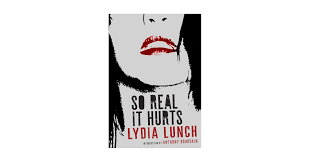
Review by Erik Noonan
I first heard Lydia Lunch on the tape deck of a friend who also played me Public Enemy, Danzig, and Suicidal Tendencies: he lived by the LA River and we would go down and walk on the dirt track and listen to music. I think the album was 13.13, and the songs were so dissonant and grim that KROQ didn’t play them, there were no videos on MTV, and the Wherehouse didn’t sell the cassette. For me, Lydia stays in an outer zone that isn’t pop, or maybe even rock, and I’ve always thought she keeps company with Linton Kwesi Johnson, Gil Scott-Heron, and other poets of the oral tradition. She has produced a large and challenging body of work over forty years. She began as a major figure of the No Wave movement in New York City in the late ’seventies and early ’eighties, fronting Teenage Jesus and the Jerks, along with spinoffs, solo projects, and collaborations. On her records, she delivers bleak rants, backed by legends. With the release of So Real It Hurts, out this summer from Seven Stories Press, Lydia expands her catalog of written works. The present volume collects pieces from the past twenty years, first printed in publications from The Rolling Stone Book of the Beats (1998) to Hustler (2014), along with a selection of new material. The book, like her music, is made with head, heart, and guts.
You can see how Lydia’s sensibility has developed. In her eulogy for the Beat muse Herbert Huncke, the earliest piece, she writes in a standard journalistic style, but by the time Gulf War Two is underway, and the economy has tanked, and the Empire has gone into overdrive, her attack on genteel self-expression lights up the page. In these later pieces, So Real It Hurts becomes an affront to everything that’s decent, upstanding, and hypocritical in American Literature. Here’s Lydia on the topic of insomnia:
No, this miserable ditty is a song of the sirens to the janitors of lunacy who have certainly not made peace, for there is none to be made, after nearly half a century of stalking Morpheus, that cruel trickster who only grants the occasional performance, and then upon a stage so soaked with blood and guts that the sheer magnitude of his insane cruelty creates a magnificent terror from which one is throttled awake, soaked in sweat, choked by tears, and stifling a scream, which, unleashed, would wake the very dead themselves, those lucky bastards to whom sleep is an eternal given.
Lydia’s writing is a jetsam mosaic to dam up against the crappy cauchemar that we’re living in. For her, our age would be better off debauched than debunked. She acknowledges the tradition of her heroes. “Henry Miller, the Marquis de Sade, Michel Foucault, E.M. Cioran, Jean Genet, and of course Hubert Selby Jr. were my main literary inspirations,” she declares. So Real It Hurts is a rabble-rouser, an attempt to turn our stomachs at the horror that the human species is capable of.
This is also a book of reckonings. Lydia comes to terms with her politics as a woman (“We especially as women need to demand our pleasure, insist upon our pleasure, because it’s the first fucking thing they stole from us”); her status as a No Wave icon (“No Wave was a collective bowel-cleansing caterwaul”); her origins in Rochester, New York (“the war that raged in my own home as the favored daughter of a door-to-door salesman who couldn’t keep his hands to himself”); her aversion to children and procreation (“Life is a sexually transmitted incurable disease”); her penchant for mutually assured destruction in matters of the heart (“to overcome, dominate, and triumph over the deadly opponent”); and her aging body (“closely monitoring the value of every morsel I stuck in my mouth”). She speaks out against the industrial minimalist babytalk of today, with a Gothic vocabulary full of disgust, charisma, and sexiness.
These are moving passages, especially alongside her takedown of the 2016 election (“the Matron Saint of Mass Murderers” versus “a bigoted, tantrum-throwing, misogynist sexual predator”) and her evocations of cities: New York (“A succubus that fed on new meat and fresh blood”); Los Angeles (“The promise of an endless summer shattered by gunshots and sirens”); and Istanbul (“Ripe with intrigue, filthy with an undercurrent of sexy repression, her sinister underbelly shrouded in aromatic blossoms”). Here, against a backdrop of distraction and violence, a woman’s spirit wages a struggle, as her courage and hope
Nemesis exposes itself.
In an introduction, Anthony Bourdain compares the author to Mercedes McCambridge, the woman gangster in the Orson Welles film Touch of Evil, not because Lydia is an especially depraved sensualist, but because she intuits that, as Thomas Hardy wrote, “If way to the better there be, it exacts a full look at the worst.” The reader who sees herself in So Real It Hurts is already en route to someplace else, within our world and beyond it.